
Hot pot · 涮
Hot pot at home, with a split pot
鸳鸯锅
Short answer: Set a split pot on an induction burner in the middle of the table: a clear broth on one side, a store-bought mala base on the other. Keep both sides at a rolling boil and cook meat and seafood through. Keep raw food cold, on its own plates, with its own chopsticks. Everyone dips at their own heat.
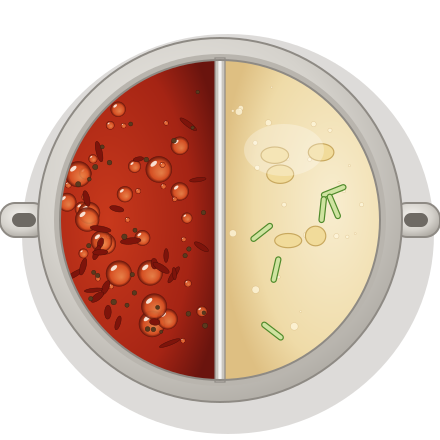
The split pot: one table, two heats
Hot pot, 火锅 (, “fire pot”), is a pot of broth kept at a boil on the table while everyone cooks raw meat, seafood, tofu and vegetables in it and dips each bite into their own sauce. The split pot, 鸳鸯锅, has a divider down the middle. China Sichuan Food describes the two usual broths as a spicy mala broth, 红汤 (, “red soup”), and a mild clear broth, 清汤 (), and a split pot lets one table have both.
That makes the split pot the every-heat vessel:
- The gentle side is 不辣 (, no heat) for everyone. Anything can be cooked in it, and anyone who wants no heat can eat from it.
- The mala side is base-bound. Its heat is cooked into the store-bought base, so it has a floor you can’t lower at the table. The heat word on the packet tells you roughly where that floor sits.
- The sauces finish each bite. A gentle-side bite dipped in a sesame dip stays 不辣; the same bite in a chili dip climbs the ladder. How the heat ladder works.
First Trip China’s advice to newcomers in Chongqing is the same: order the split pot, and treat the clear side as your relief valve.
What you need
| Item | Look for | Why |
|---|---|---|
| Burner | A portable induction burner is the recommended default. | Induction heats the pot itself, with no flame and no fuel canister at the table, and burns no gas, so it makes no carbon monoxide. Most shut off when no pot is detected. |
| Split pot | A wide, shallow pot with a divider. For induction, a base marked induction-ready. | Only certain cookware works on induction. A wide pot lets everyone reach in at once. |
| Wire ladles or small strainers | One or two per side. | They hold fragile or small pieces while they cook, and fish things out of the broth. |
| Chopsticks | Bamboo or wooden, and long. Two sets per person that look different: one for raw food, one for eating. | Wood and bamboo stay cool; long ones keep hands away from the steam. Separate sets keep raw juices off cooked food. |
| Plates | Separate plates for raw meat and seafood, kept apart from cooked food and sauces. | The same cross-contamination rule as any kitchen. |
| Small bowls | One per person for sauce, one for cooked food. | Everyone mixes their own dip. |
If you use a butane burner
Tabletop butane stoves, the kind with a gas canister lying in a compartment beside the burner, are common for hot pot. Read your stove’s own label first. Some models sold in the US are certified only for outdoor use, or for restaurants under a ventilation hood: one manufacturer’s manual says never to use its stove in an enclosed space such as a home, because it can produce carbon monoxide. CDC advises never using a portable gas camp stove indoors. Hong Kong’s and Singapore’s safety agencies, where tabletop cassette cookers are widespread, allow them with adequate ventilation. The sources disagree, so this page takes the cautious side: indoors, use induction.
Wherever a butane stove is used, these rules come from manufacturers and consumer-safety agencies, and most trace back to one danger: heat reaching the canister until it vents or bursts.
The mala side: how to read a base packet
The mala side starts from a store-bought hot pot base, 火锅底料 (): a block or pouch of fat, chili, Sichuan pepper, bean paste and spices that melts into water or stock. Follow the packet for how much water to use. This page doesn’t give a broth recipe; the gentle side is plain stock or a mild store-bought clear base.
| On the packet | What it means | What to know |
|---|---|---|
| 牛油 , beef tallow | A base built on rendered beef fat, the traditional Chongqing style. | Solid at room temperature; it melts in the pot. Rich and heavy. Not vegetarian. Leftover broth sets hard in the fridge. |
| 清油 , “clear oil” | A base built on vegetable oil, typically rapeseed oil, 菜籽油 (). | Liquid at room temperature and lighter. It is still mala. Don’t confuse 清油 with 清汤, the clear, mild broth. |
| 麻辣 | Numbing and hot: Sichuan pepper and chili together. | The flavour of the red side. |
| The heat word: 微辣 , 中辣 , 特辣 | Slightly hot, medium hot or extra hot. English packets may use a phrase such as “medium spicy”. | There is no shared standard, and brands differ; a Chongqing 微辣 can be fierce. Start with the mildest your table will enjoy. You can’t take heat out of the pot, but everyone can add it to their own bowl. |
| Ingredients and allergens | Typically chili, oil or tallow, broad bean paste, salt, spices, sugar and flavour enhancers. | Broad bean paste is usually made with wheat flour, and many bases add wheat gluten, soybeans or soybean oil. Widely sold US bases declare wheat and soy. Read the allergen line on every packet. |
| Storage line | Unopened: typically somewhere cool and dry. | Follow the label. One widely sold base says to use it soon after opening, or refrigerate what you don’t finish. |
What goes in the pot, and for how long
Keep a rolling boil; cook meat and seafood through. Add food only when the broth is boiling. Don’t crowd the pot, because a pile of cold food drops the temperature. After raw meat goes in, The Woks of Life lets the broth boil for at least 30 seconds to 1 minute before anything else comes out. Whenever you top the pot up with water or stock, wait for it to boil again.
These times are starting points from published hot pot guides and Hong Kong’s Centre for Food Safety, for thin slices and small pieces in broth that is already at a rolling boil. Thicker pieces take longer. Go by the “done when” column.
| Category | Starting point | Done when |
|---|---|---|
| Thin-sliced beef or lamb | 30 seconds to 1 minute; lamb up to 2 minutes | No pink left in the slice. |
| Thin-sliced pork or chicken | 1 to 2 minutes | Opaque all the way through. Poultry is safe at 165°F. |
| Fish slices | 1 to 2 minutes | Opaque, and flakes easily (145°F). |
| Shrimp | About 3 to 5 minutes, less for small ones; thaw frozen shrimp first | Shells red, flesh white and opaque. |
| Clams, mussels and other shellfish in the shell | Until the shells open, then 3 to 5 minutes more | Shells open and the meat is cooked through. |
| Shucked oysters | At least 3 minutes | Firm and cooked through. |
| Fish balls, beef balls and other pre-cooked balls | Up to 5 minutes; 5 to 10 from frozen | Hot all the way through. |
| Tofu, fried tofu, tofu skin | 30 seconds to 1 minute | Hot through. |
| Leafy greens | 1 to 2 minutes; add them late in the meal | Wilted and tender. |
| Mushrooms | Enoki 30 to 45 seconds; shiitake, oyster and king mushrooms 2 to 3 minutes | Soft. |
| Sliced potato, lotus root, daikon | Several minutes, depending on thickness | Tender when pierced. |
| Noodles and frozen dumplings | Noodles by the packet; frozen dumplings 5 to 10 minutes | Cooked through. |
Food safety at the table
Hot pot puts raw food and cooked food on the same table for an hour or more, so the usual kitchen rules matter more than usual.
- Separate raw and cooked. Hong Kong’s Centre for Food Safety advises separate sets of chopsticks and utensils, with different appearances, for raw and cooked food, and keeping raw and cooked food apart on the table. CDC says to keep raw meat, poultry and seafood on their own plate or board.
- Keep raw food cold until it goes in. Store raw meat and seafood in the fridge, at 40°F (4°C) or below, and bring it out in rounds rather than all at once. Perishable food shouldn’t sit out for more than 2 hours, or 1 hour above 90°F. Thaw frozen slices in the fridge, not on the counter.
- Cook only in boiling broth, and cook meat and seafood through, as in the table above. Poultry to 165°F; ground meat, as in homemade meatballs, to 160°F.
- Sauces don’t make undercooked food safe. The Centre for Food Safety notes that condiments such as soy sauce, vinegar and chili can’t kill bacteria or parasites.
- Skip the raw-egg dip unless the eggs are pasteurised. The Centre for Food Safety advises against eating cooked food mixed with unpasteurised raw egg.
The sauce bar, from 不辣 to 特辣
Sauces are where each person sets their own heat. Hot pot tables in China use a few families of dip. The northern table favours sesame paste, 麻酱 (), with lamb. Chongqing and Chengdu favour an oil dish, 油碟 (), of sesame oil and crushed garlic, and a dry chili dip, 干碟 (), for the mala side. Cantonese hot pot leans on sha cha sauce.
The Gentle Hearth sauce bar will set six sauces along the heat ladder, from a 不辣 sesame dip to a 特辣 chili dish. Full recipes publish after our test night, once they have been cooked and logged. Until then, the zero-prep tray works here too: the chili oil or crisp you already own, ground roasted huajiao, black vinegar and scallion. How to thin sesame paste for a dip.
待试 Not yet cooked: the sauce bar and the gentle broth are on the kitchen log’s list. See the kitchen log.
Leftovers
- Refrigerate promptly, within 2 hours of the meal, in shallow covered containers so the broth cools quickly. Don’t leave the pot on the burner overnight.
- Use within 3 to 4 days, or freeze.
- Bring it back to a boil before eating. Reheat broth and sauces to a rolling boil, and other leftovers to 165°F.
- Leftover raw ingredients that sat out on the table past the 2-hour mark go in the bin, not back in the fridge.
- An opened base packet: follow its label.
Plan the night on paper
Hot Pot at Home, the Split-Pot Planner, is a printable for planning a hot pot night. It goes on sale once our test night has been cooked and logged.
Sources
- Wikipedia — Hot pot
- China Sichuan Food — How to Make Hot Pot at Home (bases, divided pots, dipping sauces)
- The Woks of Life — Chinese Hot Pot: Do It At Home Like a Pro (equipment, cook times, food safety)
- Hungry Huy — The Ultimate Guide to Hot Pot at Home (cook times)
- i am a food blog — Hot Pot Recipe (cook times)
- First Trip China — How to Order Chongqing Hot Pot (split pot, clear-oil pots, the oil dish)
- U.S. Department of Energy — Making the Switch to Induction Stoves or Cooktops
- ENERGY STAR — 5 Reasons to Switch from Gas to Electric Cooking (induction-compatible cookware)
- CDC — Carbon Monoxide Poisoning Basics
- U.S. Consumer Product Safety Commission — Carbon Monoxide Information Center
- Iwatani Corporation of America — Portable Butane Gas Stove ZA-3HP instruction manual (PDF)
- Electrical and Mechanical Services Department, Hong Kong — How to Use Cassette Cookers Safely
- Consumer Product Safety Office, Singapore — Safety Tips on Portable Butane Stoves and Gas Canisters
- Health Canada — Health Canada cautions campers about portable butane stoves
- Energy Safe Victoria — Butane canister “lunchbox” cookers
- U.S. Consumer Product Safety Commission — Butane Fueled Table Top Cooking Appliances, staff project report (PDF, 2003)
- Sichuan Hot Pot Association — Beef tallow vs clear oil bases (in Chinese)
- Da Long Yi — What is the difference between clear-oil and beef-tallow hot pot? (in Chinese)
- Sohu — Chongqing and Sichuan hot pot compared (in Chinese)
- China National Radio — Sichuan Hot Pot Association responds on a unified heat standard (in Chinese), May 2023
- The Paper — Is a unified hot pot heat standard necessary? (in Chinese), May 2023
- Yihai US Food — a widely sold spicy hot pot base (ingredients and allergens)
- Yihai US Food — a widely sold hot and spicy hot pot base (ingredients, allergens and storage)
- Open Food Facts — a spicy hot pot base (ingredient list with broad bean paste and wheat flour)
- Fig — a hot pot base labelled “Medium Spicy Flavor” (ingredients and allergens)
- Hiyou — a clear-oil mala hot pot base listing
- Centre for Food Safety, Hong Kong — Food Safety Bulletin: hot pot safety tips
- Hong Kong Government — Centre for Food Safety announces test results on hot pot food samples, with safety advice (December 2025)
- U.S. Food and Drug Administration — Safe Food Handling (minimum internal temperatures)
- CDC — Preventing Food Poisoning (temperatures and separate plates)
- U.S. Food and Drug Administration — Refrigerator Thermometers: Cold Facts about Food Safety
- U.S. Food and Drug Administration — Are You Storing Food Safely?
- University of Nebraska–Lincoln Extension — Leftover Food Safety
- University of Nebraska–Lincoln Extension — Serving Soup Safely
- Xi Yang, OnlyAboutChina — The sauce difference between Sichuan and northern hot pot
- Wikipedia — Shacha sauce (ingredients)
- Omnivore’s Cookbook — Beijing Hot Pot Dipping Sauce
- U.S. Food and Drug Administration — Food Allergies